INFO ABOUT SPLIT-DALMATIAN COUNTY AND CROATIA
Who hasn't heard of Diocletian's Palace, Sinjska alka, Omis pirates evenings amphitheater in Solin, Klis Fortress ... In the Split-Dalmatia County you don't need time machine to go back to the past. Here you will find everything you need, and you only need your imagination.
Who hasn't heard of Diocletian's Palace, Sinjska alka, Omis pirates evenings amphitheater in Solin, Klis Fortress ... In the Split-Dalmatia County you don't need time machine to go back to the past. Here you will find everything you need, and you only need your imagination.
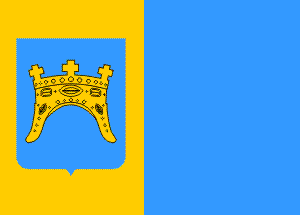
Split-Dalmatia County is the largest county of Croatia - the total area of 14106.40 km2 with population of 455,242 inhabitants. It is located in the central part of the Adriatic coast. There are 16 cities and 39 municipalities, and the headquarters is Split, the second largest city in Croatia (175,140 inhabitants). Split is an important traffic intersection, and also the largest ferry port on Adriatic coast of Croatia.
Split-Dalmatia County is the area of richest cultural and historical heritage and archaeological sites. For those who do not come just to swim and sunbathe, but want to to enjoy the landscape, history, and culture of the area there are themed trails. They provide fun learning and exploring the natural and cultural heritage and life of the local people. Some of them are: Path of the Emperor Diocletian (Solta), Paths of farmers and the ancient Romans (Vis), Path of life (Kastela) and Walk through ancient Salona (Solin). If you want a real vacation in nature, enriched by tradition of region we suggest stay in some of the ethno-eco villages. Ethno-eco-villages are a perfect place to relax with the sounds of nature and beautiful scents of Dalmatian herbs. They offer its visitors stay in centuries-old stone houses, participating in agricultural activities, collecting herbs, hiking and fishing.
Croatia is a European country and is part of the Mediterranean, as it occupies most of the coastline of the Adriatic Sea with the islands. Includes Dinara mountain range, which separates the Mediterranean part from mid-European continental, and part of the Pannonian Basin. The mainland part of the Croatian is 56 594 km2, and the surface of the coastal sea 31,479 km2, and the entire area has 4,290,612 inhabitants. Economic, political and cultural center is the capital city of Zagreb with 792,875 inhabitants. Of 1244 islands and islets, 50 of them are inhabited, and the largest are Cres and Krk. The official currency is the kuna.